

NATO Cyber Diplomacy
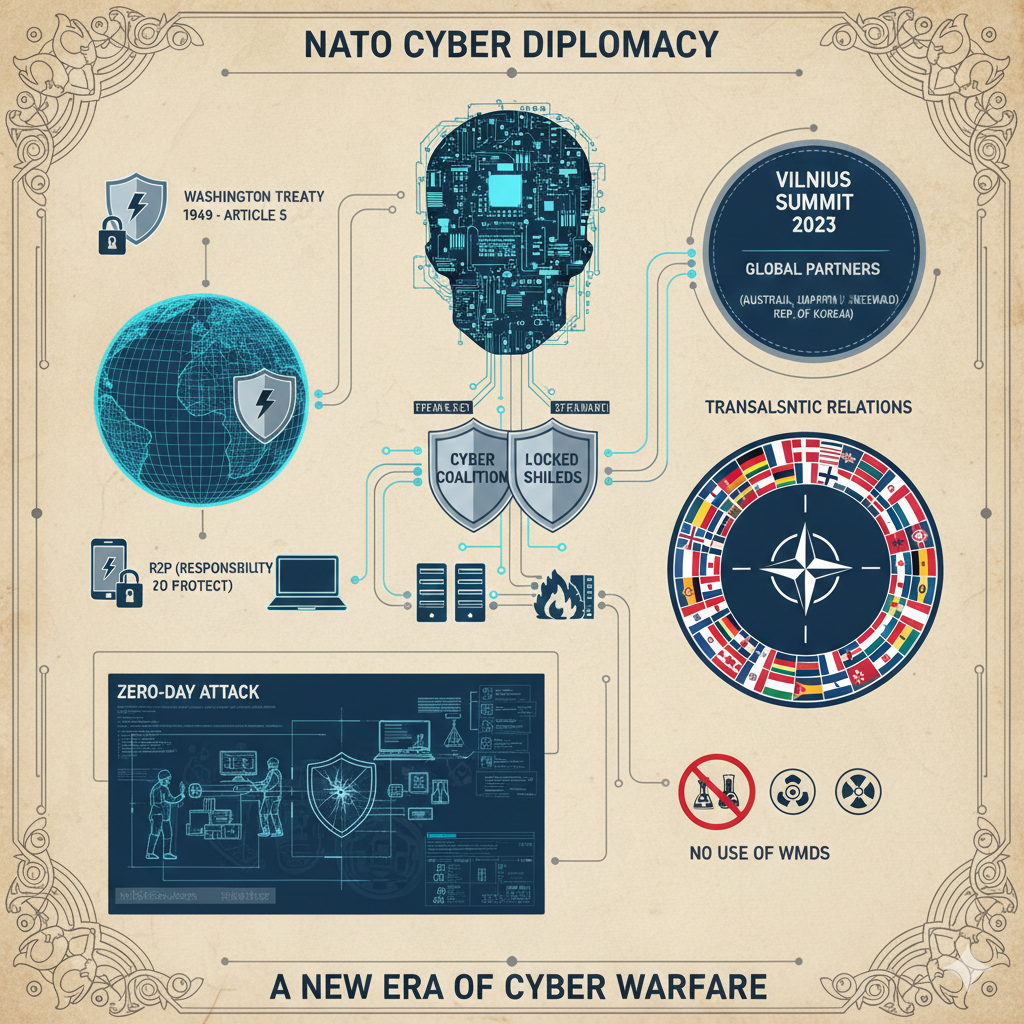
The foundations of the North Atlantic Treaty Organization (NATO) were officially laid down on 4 April 1949 with the signing of the Washington Treaty. Each member country adopts the concept of collective security through Article 5, which means that if a member state is attacked, other member states will provide military support. This is very important for cyber diplomacy in NATO. Nowadays, cyber threats and the debate over NATO alliances in transatlantic relations are central topics, including the strengthening of NATO relations through Turkey’s strategic balancing policy. Cyberspace is contested at all times, and malicious cyber events occur every day, ranging from low-level to technologically sophisticated attacks.
Whether R2P (Responsibility to Protect) is sufficient is a topic of debate in the field of International Relations. R2P means that states have a responsibility to protect their own people from genocide, war crimes, ethnic cleansing, and crimes against humanity. However, cyber diplomacy is in a difficult position within the challenge section of R2P. This relationship is debated because wars are now being waged through cyber diplomacy, and this poses a risk in terms of identifying the perpetrator. For this reason, R2P remains weak and contradictions are increasing.
A significant example is the “zero-day attack,” which exploits a previously unknown security vulnerability. These attacks can lead to serious data breaches and damage many systems, while the perpetrators may not even be identified. NATO member countries are responding by conducting large-scale cyber defence exercises such as Cyber Coalition and Locked Shields. These exercises test all steps from attack detection to response and strengthen team coordination against attacks, including simulations that exploit unknown vulnerabilities.
Cyber defence is part of NATO’s core task of deterrence and defence. NATO’s focus is to protect its own networks, operate in cyberspace, help Allies enhance their national resilience, and provide a platform for political consultation. Allies are promoting a free, open, peaceful, and secure cyberspace by supporting international law and voluntary norms of responsible state behaviour. In 2016, Allies agreed to a Cyber Defence Pledge, and in 2023, they enhanced this pledge to strengthen national cyber defences as a matter of priority, including critical infrastructure.
This situation has also affected transatlantic relations, including President Donald Trump’s controversial policy stance regarding NATO’s defence spending. At the 2023 NATO Summit in Vilnius, Allies welcomed President Zelenskyy to the inaugural meeting of the NATO-Ukraine Council and engaged with global partners such as Australia, Japan, New Zealand, and the Republic of Korea. Russia’s actions demonstrate a posture of strategic intimidation, and NATO reiterates that any use of chemical, biological, radiological, or nuclear weapons would be met with severe consequences. Cyber diplomacy, especially cyber warfare, is becoming increasingly prevalent today.

