

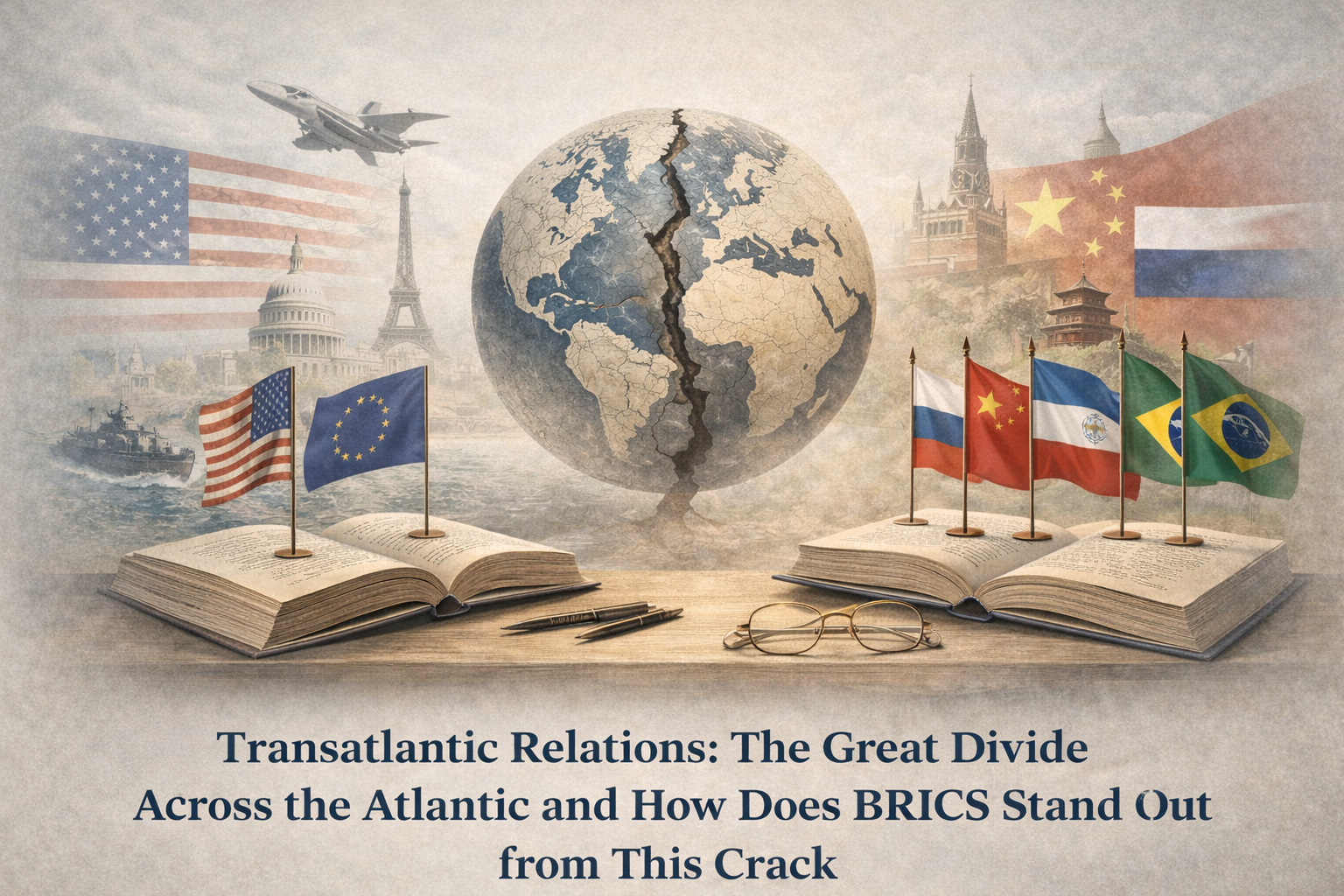
Transatlantic Relations: The Great Divide Across the Atlantic and How Does
BRICS Stand Out from This Crack
ABSTRACT
In this article, we analyze the differences between BRICS and transatlantic relations.
BRICS is a very important idea for Eastern states. Transatlantic relations analyze the relations between the USA and the European Union. NATO spending is a very big issue in transatlantic relations. Donald Trump’s controversial foreign policy is also an important factor. In BRICS, China and Russia are very strong powers. However, China is the dominant power in BRICS.
What is BRICS?
BRICS is a group formed by eleven countries: Brazil, Russia, India, China, South Africa, Saudi Arabia, Egypt, the United Arab Emirates, Ethiopia, Indonesia, and Iran. First of all, at the 2024 Kazan Summit, Russian President Vladimir Putin argued that “multilateralism is against unilateral relations.” For instance, the USA’s influence in Afghanistan, Syria, and the Gulf is evident, but the BRICS alliance particularly balances this unipolar structure. Russia’s influence in Latin America limits the absolute dominance of the United States in the region, and the global balance of power has begun to reshape itself. BRICS supports de-dollarization; they developed an alternative way with the New Development Bank.
China is a major power in BRICS because China has technology and talks about peaceful solutions, multipolarisation, and diplomacy. Iran talks about hegemony and mentions sovereignty. Iran remains a regional power in the Middle East. Iran is frequently pressured by the West; therefore, Iran advocates an independent foreign policy in BRICS. After that, BRICS says, “we develop together.” They also talk about artificial intelligence, cybersecurity, peace, and diplomacy.
A Brief History of Transatlantic Relations:
Transatlantic relations have continued as a longstanding alliance from World War II to the present day. This relationship, shaped by personal ties and shared economic and security interests, has ensured the continuation of a security architecture built together against common enemies, despite all the crises experienced. Historically, it was a period marked by deep rifts such as the 1956 Suez Crisis, the 1973 Oil Crisis, and the 2003 Iraq War. These problems were solved through mutual awareness of their need for each other.
Trump’s Controversial Foreign Policy
Trump struggled to reach an agreement with his European allies, especially on NATO’s military spending. This attitude did not quite fit with NATO’s normative character. Consequently, a trust issue arose in transatlantic relations. German Chancellor Angela Merkel said, “As Europeans, we must take our destiny into our own hands and fight for our own future.” This sentence tells us that the EU must strengthen itself and, meanwhile, re-examine its relationship with the USA.
In Eastern European countries, right-wing movements have increased. For instance, Hungarian President Viktor Orbán supported Donald Trump. Right-wing populism in Eastern Europe converged on the same ideological line. Trump’s perspective and tone toward Ukrainian President Zelensky undermined trust in transatlantic relations. The support given to Zelensky by Europe at the Ukraine Summit held in London raised questions about whether Europe has the capacity to defend Ukraine on its own, while countries such as Greece, Hungary, and Slovakia, which did not attend the Summit, emphasized that Europe was unable to present a united front on this issue (Foreign Policy Institute, Associate Professor Sinem Ünaldılar).
How Does BRICS Stand Out from This Crack?
BRICS’ opportunistic and pragmatic foreign policy approach has enabled it to expand its maneuvering space in the global system by taking advantage of the structural cracks emerging in transatlantic relations. Pragmatic rather than normative partnerships in the Global South, and especially China and Russia’s counterbalance policy against the USA, have strengthened BRICS’ position. Without NATO, the EU is powerless. This is a fact.
As a result, the Biden era was a very good strategic period for transatlantic relations. In Eastern countries, right-wing parties support Donald Trump, but France and Germany considered Trump’s policies wrong. BRICS was somewhat fortunate due to these cracks in the transatlantic relationship.

